
- All
- Product Name
- Product Keyword
- Product Model
- Product Summary
- Product Description
- Multi Field Search
Views: 0 Author: Site Editor Publish Time: 2026-06-03 Origin: Site


Industrial facilities face skyrocketing costs for waste disposal today. Stricter environmental compliance mandates, such as Zero Liquid Discharge (ZLD) protocols, force plant managers to rethink legacy waste strategies. Paying to transport water-logged waste drains facility budgets rapidly. Decision-makers need robust, highly targeted systems to minimize ultimate waste volume rather than deploying generic tools.
While a Filter press is not a universal silver bullet, it serves as a highly specific, high-yield solution designed for maximum volume reduction. This article will help you evaluate if this technology aligns with your facility's sludge characteristics, capital limits, and operational workflows.
We will explore how it performs against continuous alternatives, examine its batch-process realities, and outline critical evaluation criteria. You will gain a clear framework to determine if this equipment is the correct long-term investment for your site.
Maximum Dryness: Filter presses achieve the highest cake solid concentrations (typically 30–60%+, and up to 95% with thermal integration) among mechanical dewatering options.
ROI Driver: The primary financial return comes from drastic reductions in waste volume (up to 95%), which significantly cuts hauling and landfill fees.
Operational Trade-off: As a batch-process system, it requires dedicated cycle times (1–5 hours) and buffer storage, unlike continuous methods like screw or belt presses.
Ideal Fit: Highly recommended for abrasive, complex, or hazardous industrial sludge where ultimate dryness outweighs the need for continuous, unattended operation.
Hauling water penalizes your operational budget. When facilities dispatch waste off-site, they pay primarily by weight and volume. Every percentage point increase in cake dryness exponentially decreases hauling tons. If you upgrade from a system yielding 20% dry solids to one yielding 40%, you effectively halve your total waste disposal volume. This direct correlation makes cake dryness the single most critical factor for return on investment.
Performance metrics clearly favor static pressure systems. Standard configurations routinely achieve 25–50% dry solids. This easily surpasses the baseline requirements for standard hazardous waste disposal. Some advanced membrane designs push this metric even higher. Generating a drier, structurally stable cake prevents the sludge from being classified as a liquid waste. This reclassification alone can drastically lower disposal tipping fees.
You must also analyze the capital versus operational expenditure profile. These systems require higher initial capital investment (CAPEX). They also demand a larger spatial footprint to accommodate plate expansion. However, they boast inherently low energy consumption. The system utilizes efficient pneumatic or hydraulic diaphragm pumps to move fluid. It avoids the massive, energy-intensive rotational motors found in alternative decanter systems. Over a ten-year lifespan, this electrical efficiency compounds into significant financial savings.
Choosing the right sludge dewatering equipment requires comparing core mechanisms. Different technologies excel in entirely different environments. We must evaluate continuous throughput against ultimate moisture reduction.
Performance Comparison Chart of Dewatering Technologies | ||||
Technology | Typical Cake Dryness | Operation Mode | Energy Consumption | Best Suited For |
|---|---|---|---|---|
Filter Press | 30% - 60%+ | Batch | Low | Abrasive, hazardous, high-dryness targets |
Screw Press | 15% - 25% | Continuous | Very Low | Biological, low-concentration municipal sludge |
Centrifuge | 25% - 40% | Continuous | High | Space-constrained facilities, oily sludge |
Belt Press | 18% - 25% | Continuous | Medium | High-water biological sludge, paper mills |
Screw presses operate by slowly driving a helical auger inside a cylindrical screen. The friction and decreasing pitch squeeze water outward.
Pros: They offer continuous operation. You can automate them easily for unattended overnight runs. They also feature a compact, often vertical, footprint.
Cons: They produce lower cake dryness, typically stalling at 15–25%. The high-shear mechanical action often breaks down delicate flocs. Consequently, operators must use higher doses of expensive polymer chemicals to keep the sludge bound together.
A decanter centrifuge uses rapid rotation to separate solids from liquids via extreme centrifugal force.
Pros: They require a very small footprint relative to their processing volume. They accept continuous feed and achieve decent dryness levels, generally landing between 25–40%.
Cons: They incur massive operational energy costs. The high-speed rotation generates substantial noise. Maintenance proves expensive and complex, requiring specialized technicians to balance and repair the rotating internal assemblies.
Belt presses feed sludge between two tensioned, porous belts navigating a series of serpentine rollers.
Pros: They handle biological or high-water sludge reasonably well. They provide continuous operation and scale easily for massive municipal volumes.
Cons: They yield the lowest cake dryness, hovering around 18–25%. They demand high continuous wash-water volumes to keep the belts clean. Furthermore, they struggle immensely when processing highly abrasive slurries, which chew through the belt fabric quickly.
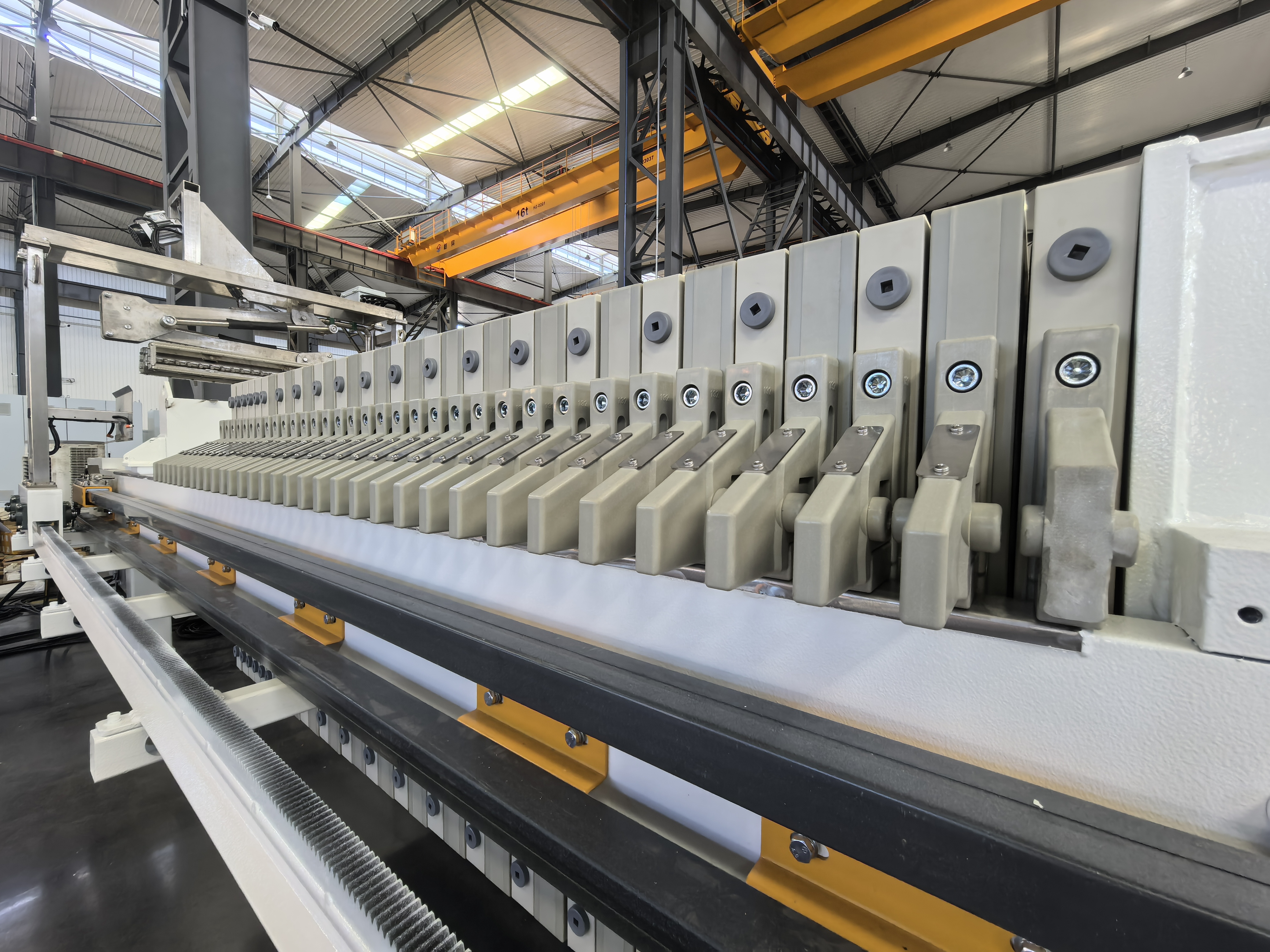
Unlike continuous systems, batch processing isolates dewatering into discrete time blocks. You must understand this cycle to determine if it fits your production schedule. The standard operation phase moves through four distinct steps. First, the feed pumps fill the internal chambers. Second, the system squeezes the sludge, ramping up pressure to force filtrate through the cloths. Third, a blowdown or wash cycle pushes compressed air through the core to clear residual moisture. Finally, the hydraulic ram retracts, and the plates separate to discharge the solid cake. This entire process requires 7 to 20 bar of pressure. It generally takes between one to five hours, depending on sludge chemistry.
You must address the upfront bottleneck. Because the equipment processes fixed batches, it cannot directly accept a continuous pipe feed from a production line. Batch processing requires upfront holding tanks. These tanks act as a buffer capacity. They accumulate the continuous upstream wastewater flows while the dewatering cycle runs. Proper tank sizing prevents upstream production halts.
Process integration offers significant efficiency upgrades. The Dissolved Air Flotation (DAF) advantage is a prime example. DAF units inject microscopic air bubbles into wastewater, floating suspended solids to the surface. Integrating DAF can output 4–5% dry matter sludge directly into the chambers. This eliminates the need for massive intermediate thickening tanks. It shrinks your overall equipment footprint while accelerating the fill cycle.
Best Practices for Mitigating Downtime:
Automatic Plate Shifters: Manual cake discharge requires intense physical labor. Automatic shifters separate plates mechanically, speeding up drop times and protecting operators.
Automated Pump Controls: Gradually ramping up feed pressure prevents sudden compaction. Automated step-up systems (e.g., shifting from 25, to 50, to 100 psi) extend cloth longevity.
Durable Cloth Materials: "Cloth blinding" happens when fine particulates embed permanently into the fabric weave. Selecting monofilament nylon or specialized polypropylene drastically reduces blinding and cuts cleaning frequency.
Before committing capital, you must scrutinize your specific operational environment. Industrial sludge dewatering requires precision matching between machine and material.
First, evaluate sludge consistency and chemistry. Determine if the material is abrasive, hazardous, or biological. Heavy mining tailings and metal hydroxides match perfectly with static chamber designs. The lack of moving internal friction parts protects the machinery from abrasive wear. However, sticky, low-concentration biological sludge behaves differently. It can quickly clog woven filter cloths. Biological sludge is often better suited for continuous screw presses.
Next, consider your chemical conditioning needs. Some industrial streams require heavy pre-treatment. Adding lime improves dewatering performance significantly, creating a porous matrix for water to escape. However, evaluate the tolerance for added weight. Lime increases the overall dry mass. You must calculate if the reduced water weight offsets the added chemical weight for disposal fees.
Sizing and scalability dictate your engineering blueprint. Sizing logic relies on precise mathematical formulas rather than guesswork. Follow these steps to determine equipment scale:
Calculate Daily Flow Rate: Measure the total volume of wet sludge generated per shift.
Determine Dry Solid (DM) Percentage: Test the incoming slurry to find the exact ratio of suspended solids to liquid.
Assess Sludge Density: Heavier mineral slurries require stronger structural frameworks than light organic waste.
Define Cycle Frequency: Decide how many batch cycles your team can run daily (e.g., two 4-hour cycles vs. three 3-hour cycles).
Based on these inputs, engineers calculate the required total chamber volume. Plate sizes typically range from small 800mm pilot models to massive 2500mm heavy-industry units.
Common Mistake: Skipping the pilot test. Lab-scale feasibility testing is a non-negotiable step. A simple Buchner funnel bench test reveals polymer demands and baseline filtration rates. Following that, renting a pilot-scale unit validates cycle times and cake release characteristics under real-world conditions.
Certain sectors inherently demand the extreme performance metrics offered by static pressure systems. The return on investment accelerates rapidly when handling challenging industrial wastewater.
Heavy Industry & Mining: Mining operations generate massive volumes of abrasive tailings and rock slurries. Wear-resistance is critical here. Because the slurry rests statically between plates during compression, internal abrasion remains virtually zero. This sharply contrasts with decanter centrifuges, which suffer catastrophic wear from silica and hard minerals.
Chemical & Metal Finishing: Electroplating and surface treatment facilities produce hazardous metal hydroxides. Environmental agencies heavily regulate these substances. Hazardous waste disposal costs carry a premium surcharge. Achieving a 50% dry cake rather than a 25% wet sludge slashes exorbitant regulatory disposal fees. The equipment easily handles the highly corrosive environments associated with chemical etching.
Data Centers & High-Tech: Modern hyper-scale data centers consume millions of gallons of water for server cooling. Treating cooling tower blowdown presents a unique challenge. This graywater contains extreme levels of Total Dissolved Solids (TDS) and proprietary scale-inhibitors. To meet stringent ESG (Environmental, Social, and Governance) targets and ZLD mandates, facilities must extract dry solids and recycle the clear filtrate back into the cooling loops.
Industry Specific Benefits Matrix | ||
Industry Sector | Primary Sludge Challenge | Key Benefit Delivered |
|---|---|---|
Mining / Aggregates | Extreme abrasion, high density | Zero internal moving parts prevents wear |
Metal Plating | Hazardous chemical toxicity | Maximum volume reduction cuts premium fees |
Data Centers | High TDS, ESG compliance | Enables ZLD and graywater recycling |
A batch-based pressure system remains the optimal choice if minimizing final waste volume, handling abrasive solids, and achieving maximum dry cake are your top operational priorities. The dramatic reduction in off-site hauling fees typically justifies the initial infrastructure investment. Conversely, it is not the best solution if your facility strictly requires a continuous, highly automated system to handle sticky, low-concentration biological sludge.
To move forward, initiate a comprehensive sludge composition analysis at your facility. Partner with a reputable equipment manufacturer to schedule a pilot test. This hands-on testing phase will validate your required cycle times, confirm chemical dosing requirements, and finalize the exact plate dimensions needed for your site.
A: It typically operates at 6 to 7 bar for standard municipal or light industrial applications. However, high-pressure and specialized membrane configurations can reach up to 16 to 20 bar. This higher pressure enables secondary squeezing, which extracts residual moisture from difficult slurries.
A: Standard woven cloths easily capture suspended solids down to 5–25 microns. If your process requires extreme clarity, operators can introduce precoat materials or filter aids (like diatomaceous earth). With these additives, particle retention drops dramatically to 1–2 microns.
A: No. It relies primarily on pneumatic or hydraulic diaphragm pumps to move fluid. It completely avoids the massive rotational motors required by centrifuges. Consequently, the overall electrical energy consumption is significantly lower than high-speed decanting alternatives.


